

Skin Cancer Screenings & Mole Mapping
House of Dermatology provides comprehensive medical care to help patients maintain healthy skin. A professional skin cancer screening in Alpharetta, John’s Creek, Milton, Roswell, and Cumming is the first step in proactive health management. Dr. Ravi R. Patel focuses on early detection to identify concerns before they progress into serious issues.
Skin Cancer: Understanding, Prevention, and Treatment
Why Annual Skin Exams are Critical
The ABCDEs of Melanoma: What to Look For
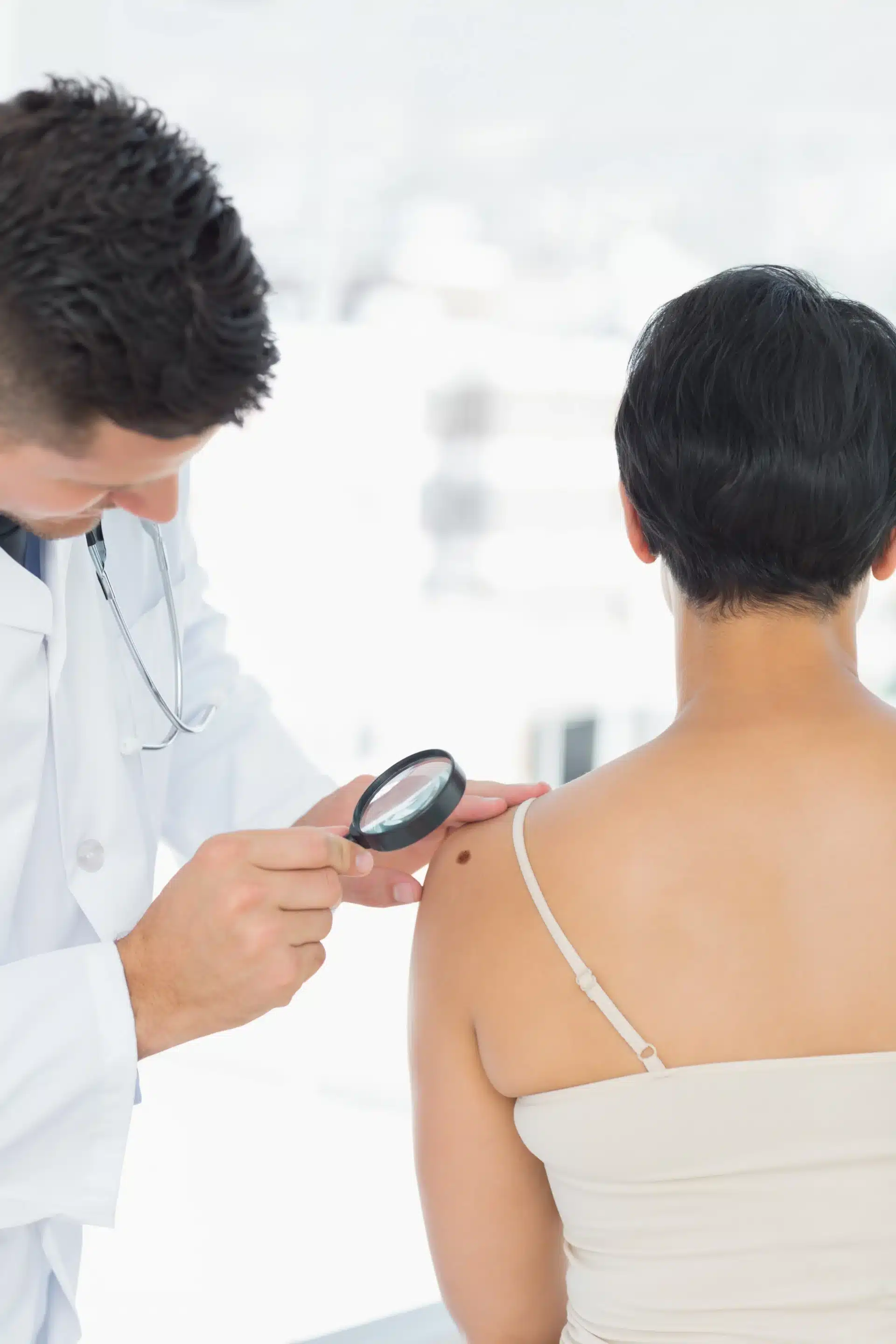
Self-monitoring is a vital component of melanoma detection. Patients are encouraged to use the ABCDE method between office visits to identify suspicious spots. Mole mapping can help track these markers over time.
- Asymmetry: One half of the mole does not match the other.
- Border: The edges are irregular, ragged, or blurred.
- Color: The pigmentation is not uniform and may include shades of brown, black, blue,grey or red.
- Diameter: The spot is larger than six millimeters, or about the size of a pencil eraser.
- Evolving: The mole changes in size, shape, or color over a short period.
Types of Skin Cancer
Our practice offers specialized non-surgical and surgical dermatology for various forms of the disease. There are three primary types of skin cancer, each named for the type of cells affected:
Basal cell carcinoma (BCC)
Basal cell carcinoma is the most common form of skin cancer, arising from basal cells in the lowest layer of the epidermis. It tends to grow slowly and seldom spreads to other parts of the body.
Squamous cell carcinoma (SCC)
Squamous cell carcinoma begins in squamous cells, which compose most of the skin’s upper layers. SCC is more likely than BCC to invade fatty tissues beneath the skin or spread to distant parts of the body.
Melanoma
Melanoma is the most aggressive type of skin cancer, originating in the melanocytes, or the cells that produce melanin. Melanoma can spread quickly to other organs, making it the most dangerous form of skin cancer.
Skin Cancer Causes and Risk Factors
- Excessive sun exposure
- Use of tanning beds
- Having fair skin, light hair, and blue or green eyes
- Family history of skin cancer
- Being over the age of 50
- Having a large number of moles or abnormal moles
Prevention and Sun Safety
- Use sunscreen: Apply a broad-spectrum sunscreen with an SPF of 30 or higher, even on cloudy days.
- Wear protective clothing: Long-sleeved shirts, pants, and broad-brimmed hats can provide additional protection.
- Seek shade: Avoid the sun during its peak intensity hours, usually between 10 a.m. and 4 p.m.
- Avoid tanning beds: They can significantly increase the risk of skin cancer.
Skin Cancer Signs and Symptoms
- New growths or sores that do not heal
- Changes in existing moles, such as an increase in size, irregular edges, or color changes
- Small, smooth, pearly, or waxy bumps
- Flat, red spots that are rough, dry, or scaly
Early Detection and Self-Examination
Skin Cancer Screening and Biopsy
Treatment Options for Suspicious Lesions
For confirmed cases, options include non-surgical superficial radiotherapy, surgical excision, or specialized Mohs surgery. We also address actinic keratosis to prevent the development of future malignancies.
Treatment Options
- Surgical removal: The most common treatment for skin cancer, involves the removal of the tumor and some surrounding tissue.
- Radiation therapy: Uses high-energy rays to target and kill cancer cells.
- Chemotherapy: The use of drugs to kill cancer cells; sometimes applied as a cream or lotion for cancers limited to the top layer of the skin.
- Immunotherapy: Boosts the body’s natural defenses to fight cancer.
- Cryotherapy: This treatment uses extreme cold to freeze and destroy cancer cells.